The most valuable AI in dealer quoting isn't the AI that writes quotes
For a machinery dealer, the AI that pays off in quoting works upstream — preparing and maintaining the price data — while the shipped system stays a simple app the sales team actually uses.

Most of the AI a machinery dealer is being sold for quoting is pointed at the wrong part of the problem. The pitch is a tool that reads a catalog and writes the offer. The work that actually decides whether quoting gets faster sits upstream of that, in the price data — and it is unglamorous, it is continuous, and it is where the engineering lives.
We build custom software with applied AI for machinery dealers and distributors, and quoting is the workflow we are asked about most. This is what we have learned putting it into production: the interesting engineering work in a dealer quoting project is almost never the model. It is getting five different manufacturers' price books into one clean structure, keeping them current as new lists arrive every quarter, and shipping a simple application the sales team will open on a Tuesday morning without being told to.
What the market is selling
There is a fair version of the "let AI write the quote" pitch, and it is worth stating before taking it apart. PDFs, emails, and inbound requests contain real commercial intent. A model can extract line items, match them to products, draft a scope, and turn an hours-long first pass into minutes. Vertical vendors — ServiceCPQ for heavy equipment, or the distributor tools like BoltWise and Proton — add domain vocabulary and ERP integration on top. The dealer buys a faster quote, not a data project. On paper that is the cleaner sale.
In practice it does not hold, and it fails in a specific, testable place. The failure is not that models are bad at language. It is that these tools quietly put a probabilistic system into the live price path — the one place in a quote where being approximately right is the same as being wrong. A price that is invented, or lifted from last quarter's list, or attached to the wrong mast configuration, does not read as a bug to the customer who receives it. It reads as your offer.
This is the part that does not show up on the demo. In the demo the catalog is clean, the PDF is one manufacturer, and the price the model returns happens to be right. The system that has to live for five years inside a two-hundred-person dealer, across five brands whose price books arrive in five different formats, is a different object.
Separate the three jobs vendors blend
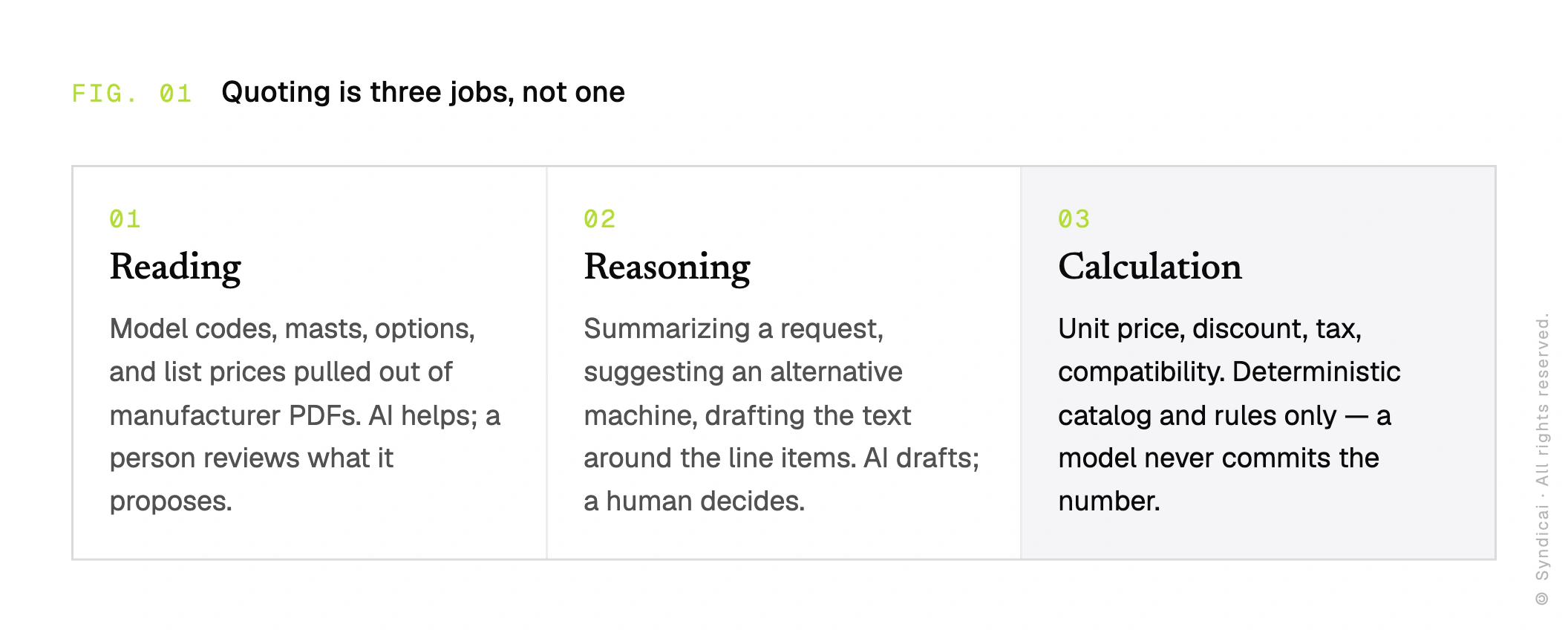
The confusion comes from treating quoting as one AI task. It is three, and they have different tolerances for error.
The first is reading unstructured data — pulling model codes, mast types, options, and list prices out of a manufacturer PDF or spreadsheet. The second is commercial reasoning — summarizing a request, suggesting an alternative machine, drafting the descriptive text around the line items. The third is calculation — committing to a unit price, a discount, a tax treatment, and a compatibility rule.
AI helps with the first two. It should be nowhere near the third. A model may propose data for a human to accept; it must never be the system of record or the final calculator for a price. That boundary is concrete, it is testable, and — this is the part that matters — it is compatible with useful AI rather than a rejection of it. The honest version of the thesis is not "never let a model touch a quote." It is: probabilistic tools where a mistake can be reviewed before it is published; deterministic, versioned services where the business commits to a number.
The evidence for drawing the line exactly there is not ours alone. Retrieval-augmented generation — grounding a model in your own current documents rather than its training weights — genuinely improves factual accuracy, which is why it is the right first move over fine-tuning for data that changes (Microsoft, 2024). But it reduces error; it does not remove it. RAGTruth, a peer-reviewed corpus of 18,000 hand-annotated retrieval-augmented responses, exists precisely because grounded systems still hallucinate at rates worth measuring (Niu et al., 2024). And the raw material here is the hard case: on a benchmark of long, real-world PDFs, the best frontier model of 2024 scored an F1 of 44.9 on document questions, with a fifth of the questions unanswerable from the document at all (Ma et al., 2024). "Upload the price book, get reliable structured truth" is not a solved problem. It is the problem.
So the price does not come from the model at quote time. It comes from a structured catalog that was built from the manufacturer's list, reviewed, versioned, and published — and the app reads from that. AI did the reading and the first-pass structuring. A person accepted it. After that, the number is deterministic.
| AI in the live price path | AI in the data behind the offer | |
|---|---|---|
| What the model does | Reads the PDF and answers "what's the price?" at quote time | Extracts and structures the catalog once; a person reviews it |
| Where the price comes from | Generated per quote, from retrieved or remembered text | A versioned catalog, queried deterministically |
| When an error surfaces | In front of the customer, inside the offer | In a review queue, before anything ships |
| What changes every quarter | Nothing visible — until a wrong number goes out | A controlled re-import and review of what changed |
| Who is accountable for the number | Unclear — "the AI" | The person who approved that catalog version |
The trap nobody quotes for
Here is the pattern that convinced us the real work is upstream. We have watched a firm automate exactly the step the market sells — extracting data from a manufacturer PDF, a task that had taken a person about an hour by hand. Six months later, the process still took about an hour. The tool pulled the data in five minutes. Then the person who owns the data checked what it produced for the other fifty-five.
Treat that ratio as a field note, not a benchmark — it is one engagement, and the honest thing is to measure it rather than repeat it. But the mechanism behind it is not new, and it is not specific to AI. Lisanne Bainbridge described it in 1983: automating the easy part of a task tends to leave the human with the harder residual — the monitoring, the verification, the exception handling — and can make that residual worse (Bainbridge, 1983). Automate the visible five minutes and you have not touched the fifty-five. The non-intuitive skill in this work is knowing which part to automate, and it is almost never the part that demos well.
Which is why the win, when it comes, is usually smaller and more boring than the pitch. On the early stage of these engagements we often take AI out of the quoting step entirely and ship a simple application over a clean price catalog. That alone tends to resolve most of the problem — because the problem was rarely "our quotes are not AI-generated." It was that every salesperson kept their own offers, no one could see anyone else's, numbering was inconsistent, and the newest price list lived in someone's inbox. A working demo is the cheapest part of an AI system. A quiet catalog that everyone quotes from is the actual deliverable.
Why not just buy a suite
The strongest objection to all of this is not "use ChatGPT." It is the enterprise suite: put quoting inside a mature configure-price-quote system — SAP CPQ, Salesforce Revenue Cloud, Tacton — that already owns products, permissions, pricing rules, and the audit trail. That is a real answer, and for some dealers it is the right one. A suite enforces margin rules and connects the quote to the rest of the business in ways a small app does not.
There are two ways this usually goes. If the dealer's problem is a full quote-to-cash transformation across a large organization, the suite earns its cost. If the problem is a narrow quoting bottleneck across five brands with messy catalogs and no in-house platform team, a quote-to-cash program is a large answer to a small question — and large answers to industrial software questions have a documented failure rate. A review of more than sixty major ERP transformations found more than 80% ran over 200% past budget and missed their timelines (Kearney, 2023). That is enterprise-scale evidence and should not be stretched to "all software fails." But it names the risk of starting big when you could start where it hurts.
The argument is not that suites are bad. It is that you earn the right to expand after you have solved one measurable workflow. Quoting is a good place to start precisely because it sits at the front of the sales path: a quoting app needs no integration with accounting, no customer import, no migration — offers go to new prospects. You can build the clean price catalog once, ship the app, let the firm see it work, and only then decide whether the next workflow wants a suite or another small tool.
The boundary, stated plainly
Custom AI is not a synonym for expensive AI. It is a synonym for AI that fits the operational reality of the dealer's business — and that reality is that prices change every three to six months, catalogs are heterogeneous, and the person who will be blamed for a wrong number is a salesperson standing in front of a customer, not a model.
So the shift is this. Stop asking whether the AI can write the quote. Ask where the AI can carry error that a human reviews before anything ships, and where the system must be deterministic because the business is committing to a number. Put the intelligence in the data behind the offer — the extraction, the structuring, the quarterly maintenance nobody scopes and everybody pays for. Ship the boring app on top. In dealer quoting, AI earns its place in the data behind the offer, not in writing it — and what ships is a simple app the sales team uses, not a clever model.
Five questions to ask an AI quoting vendor before you sign: where does the price come from when a quote is built; is a model ever the final decider of a price, discount, tax, or compatibility rule; what happens when a manufacturer's price list changes; is your quoting data used to train any AI model; and can you reproduce a quote exactly as the customer received it three months ago.
It is not the most impressive thing to sell, but it is the thing that stays running. The only honest way to find out where AI belongs in your quoting is to build the smallest real version on your own price list and look — which is what the first two weeks of a discovery sprint produce: a working prototype, not a slide deck. The rest is operations, not theatre.