Production wins are boring — what mid-market AI deployments quietly become
The mid-market AI deployments that reach production look small, not transformative. Why the demo register hides the wins that actually compound.
A few years ago, in the period when we were still operating a software platform for ML model deployment, one of our smaller customers — a team in the southern United States — wrote in to ask about a monitoring feature we had described during the sales cycle. They had just put their first models into production. They wanted to see resource utilisation, model performance, and a few cloud-side metrics, the way our roadmap had promised. They were not unreasonable about it. They were doing exactly what we had told them they would be able to do.
We knew the honest answer. Building the dedicated monitoring product properly — the version that would have lived inside the platform UI, with the right access controls and a usable design — was a three-month engineering project. We did not have three months. We had a customer who had already deployed, who needed visibility now, and who was sitting on a quiet operational risk every day until we shipped something.
The instinct, in startups of that age, is to commit to the build. To take the request as a roadmap promise and tell the customer the dates. We had done that on other features. We almost did it on this one.
What we would have done a year earlier
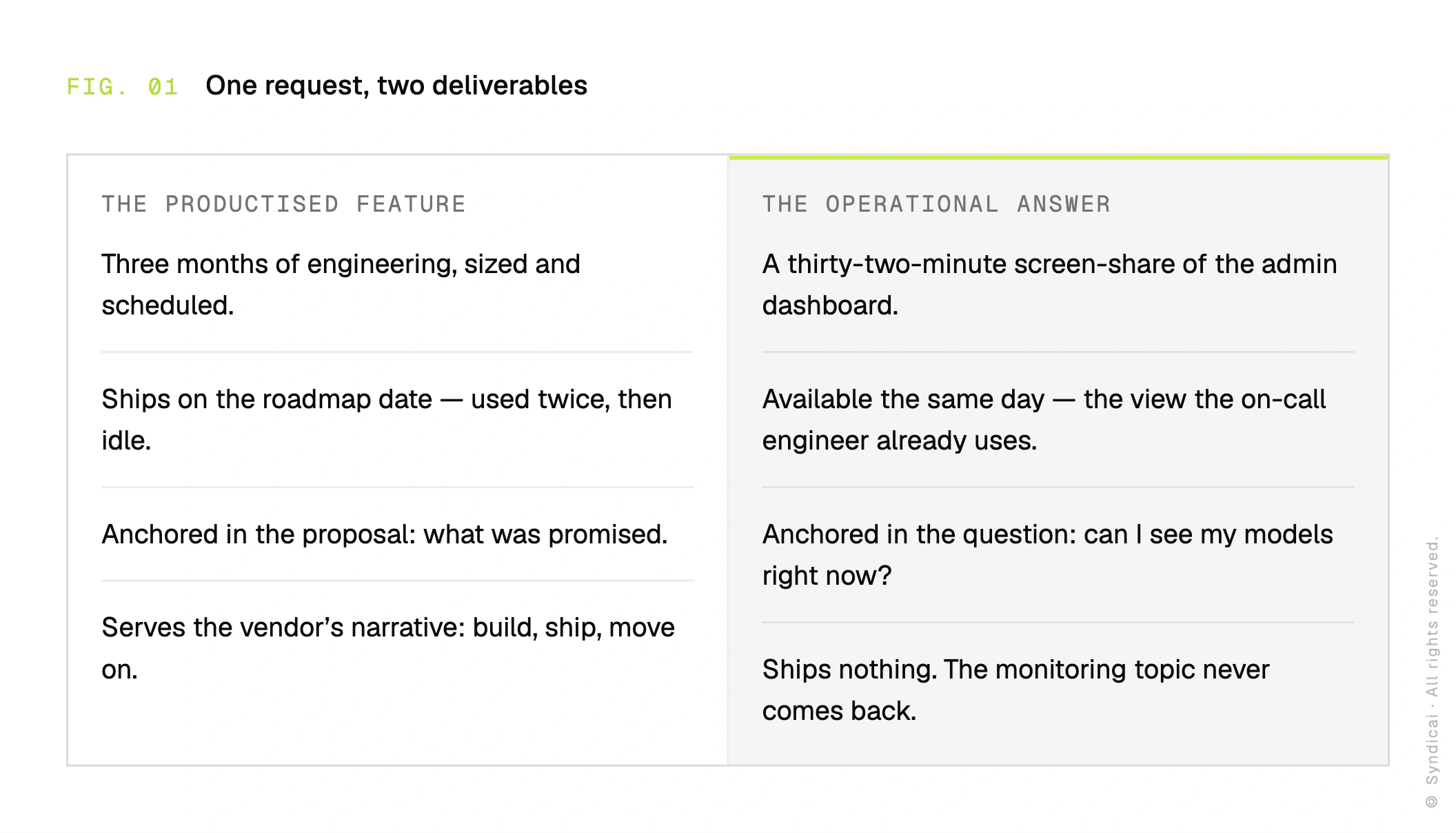
A year earlier, we would have agreed. We would have written an internal kickoff document, sized the work at fourteen to sixteen weeks, scheduled it into the next quarter, and sent the customer a polite update with a target date. The customer would have thanked us. Three months later, if we had hit our timeline, we would have shipped a monitoring product that we believed was good. The customer would have used it on day one, and probably twice in the following week, and then the team that had been waiting on it would have moved on to the next concern. The product would have lived in the UI for the rest of the platform's life, mostly unused.
That was the win we knew how to deliver. The win that fit our roadmap, our story, our investor narrative. Build the feature. Ship the feature. Move on to the next one. It is, in the platform-startup register, what a "production win" looks like.
What it actually was, in retrospect, was a demo win wearing production clothing. The work was real. The deliverable was real. But the customer's actual need — visibility into their first production deployment, today, before something went wrong — was not what the three-month build would have served. It would have served our roadmap. The customer's need would have been served on day one by something we already had.
The afternoon we asked a different question
The fix, when it came, was operational. One of our engineers — the person who carried the pager for the platform — pointed out that what we had shown the customer in the proposal was not the only thing we could show them. We already had a monitoring view internally. We used it to operate the platform. It looked nothing like the productised version we had described, but it had everything the customer was actually asking about: resource utilisation, model latency, error rates, cloud-side telemetry. We were running on it ourselves.
We wrote the customer back and offered a thirty-minute screen-share. We would walk them through the admin-side dashboard, the same one our on-call engineer used at three in the morning when something broke. They would tell us which views were useful, which were noise, and what they were watching for. We would not ship a product. We would show them how we ran the system.
They agreed. The call took thirty-two minutes. By the end of it, they had checked everything they were worried about. They had a screenshot of the relevant tab pinned in their incident-response document. The conversation, on the topic of monitoring, did not come back. Not the next month, not the next quarter, not at renewal.
We did not ship the monitoring product. We never built it, in the form we had described. It would have been the wrong product anyway, because we had described it before we understood the customer's question. The customer's question was not where is the productised monitoring feature? It was can I see what is happening inside my models right now? The honest answer was yes, you can, today, in a less polished way than we promised — and that answer was, for this customer at this moment, the entire deliverable.
What stuck
A working demo is the cheapest part of an AI system. We learned that one across roughly the next three years of operating the platform, in dozens of similar conversations. The win that compounded — the one that kept the customer subscribed, the one we could point to later as evidence that the engineering was solid — was not the productised feature. It was the thirty-minute call where we matched their actual operational reality to something we could already show them. The shipped feature would have been a slide. The screen-share was a system.
This pattern is now well-documented outside our own engagements. Boston Consulting Group's 2024 survey of a thousand executives across more than twenty sectors found that around 70% of AI implementation challenges stem from people and process, 20% from technology and data, and 10% from algorithms (BCG, 2024). Microsoft's 2026 Annual Work Trend Index reports that organisational factors explain 67% of AI impact versus 32% for individual factors (Microsoft, 2026). Gallup's 2025 survey of more than twenty thousand U.S. workers found that 23% of employees do not even know whether their organisation has implemented AI at all (Gallup, 2025). The system that ships is rarely the system that gets adopted. The system that gets adopted is rarely the one that looked impressive in the demo.
The asymmetry between demo speed and production speed has gotten wider since foundation models became commercially available, not narrower. Chip Huyen's 2025 essay on AI engineering pitfalls describes a team that reached 80% of the desired user experience in one month and then needed four more months to get the remaining 15% (Huyen, 2025). A METR controlled trial of frontier AI coding tools, published in July 2025, found that experienced developers working in mature codebases were 19% slower with the tools than without them (METR, 2025). The fastest path to a working prototype is not the fastest path to a working production system. It might be the slowest.
A working demo is the cheapest part of an AI system. This is the part that does not show up on the demo: the evaluation harness, the regression suite, the on-call question that decides whether the system survives its first six months, the documentation that lets the next engineer onboard in two days instead of two months. The interesting engineering work in an AI project is almost never the model. It is the data pipeline, the failure modes, the integration with the system of record — the work data engineering quietly carries — and the question of who picks up the pager when something breaks on a Saturday.
What we have seen across the engagements we have run or rescued since is that the production wins are boring. They do not make for slide decks. They are a quote configurator that replaces a multi-day Word-and-Excel process with one that fits inside a working morning, for a sales team that has been waiting years for someone to take their workflow seriously. They are a service-part recommender that runs on a single small instance and quietly removes a category of phone calls the technician used to make every visit. They are a vendor-invoice parser that closes a backlog the accounting team had stopped complaining about because they had given up on anyone solving it. The demos that win procurement attention are the ones with the words transformation and platform and agent in them. The systems that win the second budget cycle are the ones that automated one workflow in one department and stayed running.
The honest admission is that we had to learn this the slow way. On the monitoring conversation, we were ready to spend three months building the wrong thing. We caught it because the engineer who carried the pager pushed back. On other engagements, in other quarters, we did not catch it. We shipped the productised version of a feature that the customer had asked for and would not use. Those are the engagements we point to internally when someone asks why we now start every Foundation Sprint with the question what does the customer need to see this week? rather than what feature did we promise them?
What changed in how we run the discovery phase
The pattern from that monitoring conversation is what we now build the first two weeks of every project around. The deliverable from a Foundation Sprint is a working prototype on the buyer's real data — not a productised feature list, not a roadmap document, not a strategy deck. The output is the thing the customer can see, use, and disagree with. The conversation that follows is anchored in an artifact, not in promises.
There is a structural reason mid-market AI projects fail at the production line, and it is not buyer maturity. It is what the vendor is paid to do. A vendor paid to build the productised monitoring feature will build it, on the quoted timeline, at the quoted price, and the customer will use it once. A vendor paid to operate the system the customer is putting into production will spend thirty minutes showing them the admin view and ship nothing — and the customer will renew. Across the engagements we have run and the ones we have been called in to rescue, the pattern is the same. The buyer was not at fault. The vendor was paid for discovery, not for operating the system that actually ships.
Production wins are boring. The rest is operations, not theatre.